
REPORT INTERPRETATION
Cardio Fitness Report (Basic)
9 Parameters
(Bilingual Report Available)

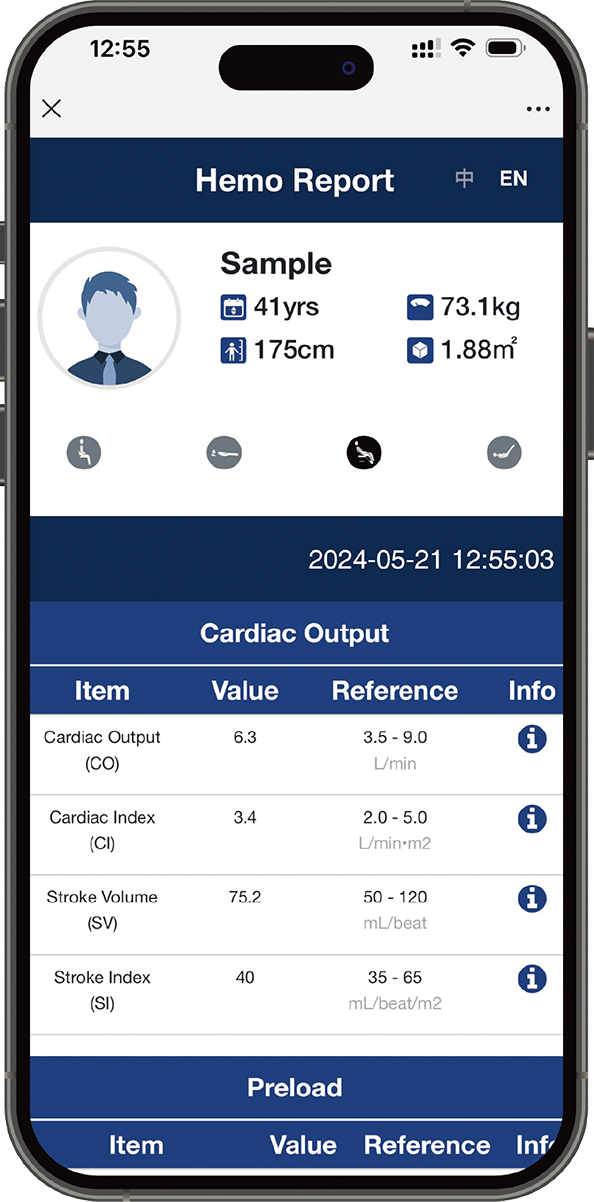

SBP: Systolic Blood Pressure (mmHg)
The amount of pressure in the arteries during the contraction of the left ventricle of the heart.
DBP: Diastolic Blood Pressure (mmHg)
The pressure in the arteries when the heart rests between beats.
HR: Heart Rate (beats.min)
The number of heart beats per minute.
MAP: Mean Arterial Pressure (mmHg)
The average of blood pressure in arteries during one cardiac cycle.
CO: Cardiac Output (L/min)
The amount of blood the heart pumps through the circulatory system in a minute. A normal adult has a cardiac output of 4.7 liters of blood per minute.
CI: Cardiac Index (L/min/m^2)
It is the cardiac output divided by the body surface area (BSA).
SV: Stroke Volume (mL/beat)
It is the amount of blood pumps out by the left ventricle in one contraction (per beat).
SI: Stroke Index (mL/beat/m^2)
The stroke volume (SV) divided by the body surface area (BSA) equals the stroke index (SI).
SVR: Systemic Vascular Resistance (dyne.s/cm^5)
Refers to the resistance to blood flow offered by all of the systemic vasculature. (Excluding the pulmonary vasculature).
Cardio Fitness Report (Pro)
16 Parameters
(Bilingual Report Available)
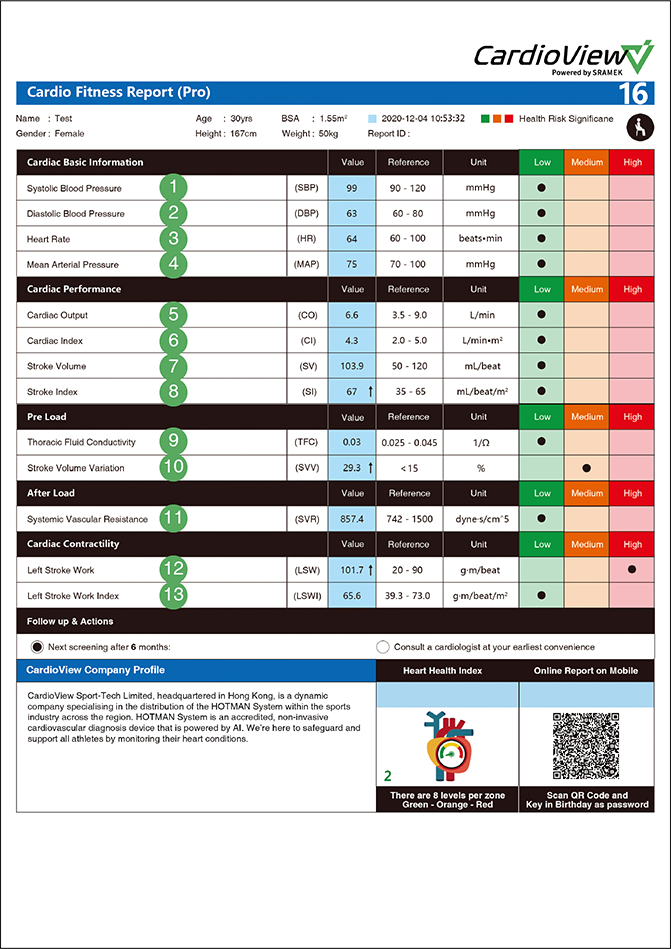

SBP: Systolic Blood Pressure (mmHg)
The amount of pressure in the arteries during the contraction of the left ventricle of the heart.
DBP: Diastolic Blood Pressure (mmHg)
The pressure in the arteries when the heart rests between beats.
HR: Heart Rate (beats.min)
The number of heart beats per minute.
MAP: Mean Arterial Pressure (mmHg)
The average of blood pressure in arteries during one cardiac cycle.
CO: Cardiac Output (L/min)
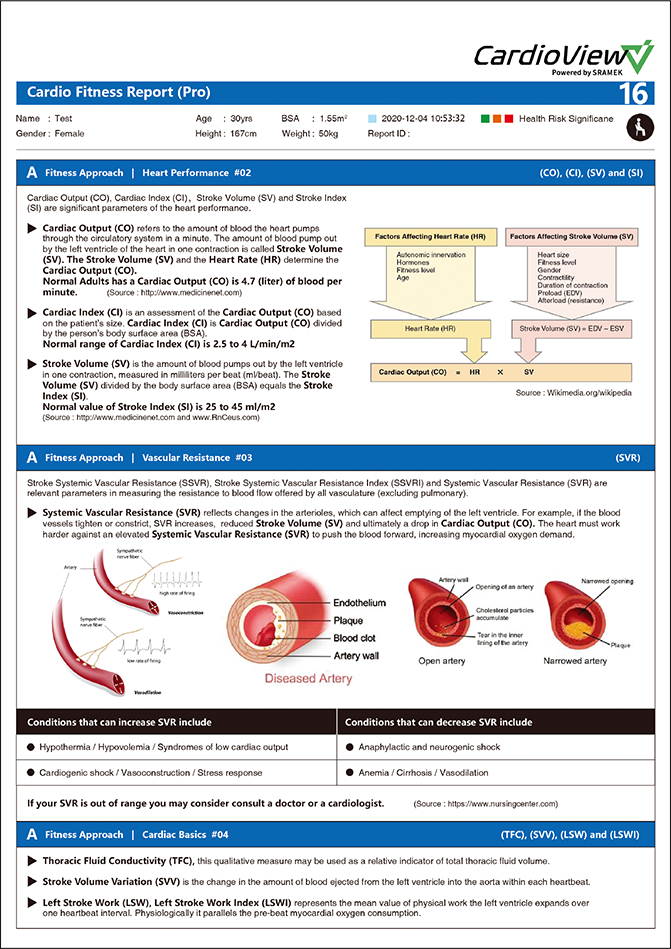
The amount of blood the heart pumps through the circulatory system in a minute. A normal adult has a cardiac output of 4.7 liters of blood per minute.
CI: Cardiac Index (L/min/m^2)
It is the cardiac output divided by the body surface area (BSA).
SV: Stroke Volume (mL/beat)
It is the amount of blood pumps out by the left ventricle in one contraction (per beat).
SI: Stroke Index (mL/beat/m^2)
The stroke volume (SV) divided by the body surface area (BSA) equals the stroke index (SI).
TFC: Thoracic Fluid Conductivity (1/Ω)
TFC is measured by reading the impedance to electrical conductivity through the chest wall. It is calculated as the inverse of the impedance across the thorax.
SVV: Stroke Volume Variation (%)
Stroke volume variation (SVV) is the change in the amount of blood ejected from the left ventricle into the aorta within each heartbeat.
SVR: Systemic Vascular Resistance (dyne.s/cm^5)
Refers to the resistance to blood flow offered by all of the systemic vasculature. (Excluding the pulmonary vasculature)
LSW: Left Stroke Work (g.m/beat)
LSW represents the mean value of physical work the left ventricle expands over one heartbeat interval.
LSWI: Left Stroke Work Index (g.m/beat/m^2)
LSWI is the Left Stroke Work divided by the Body Surface Area.
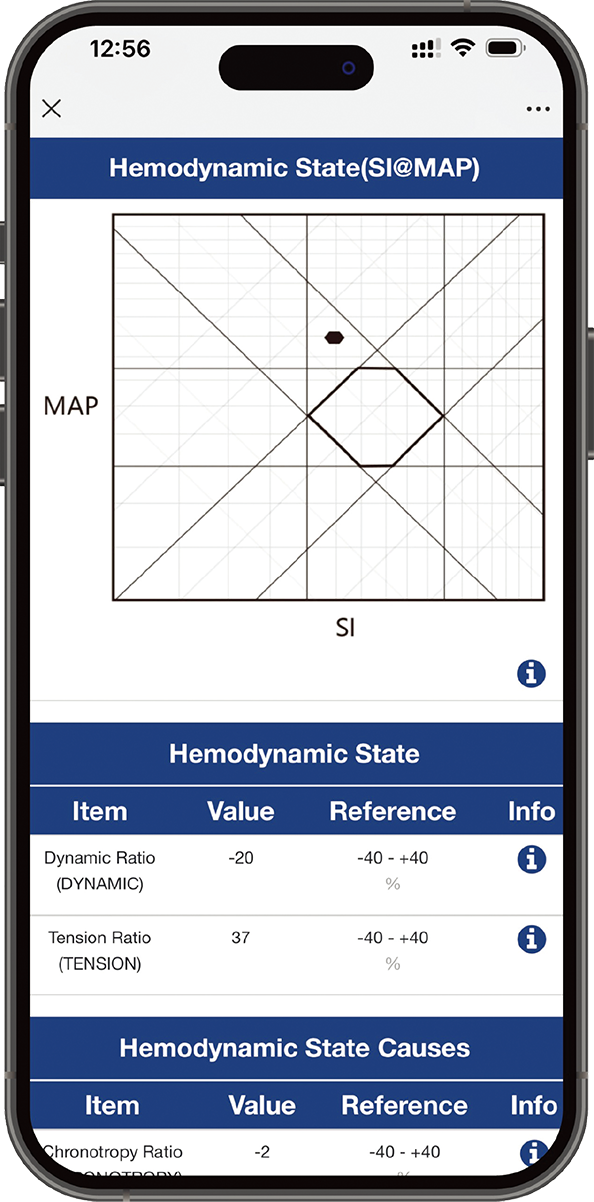
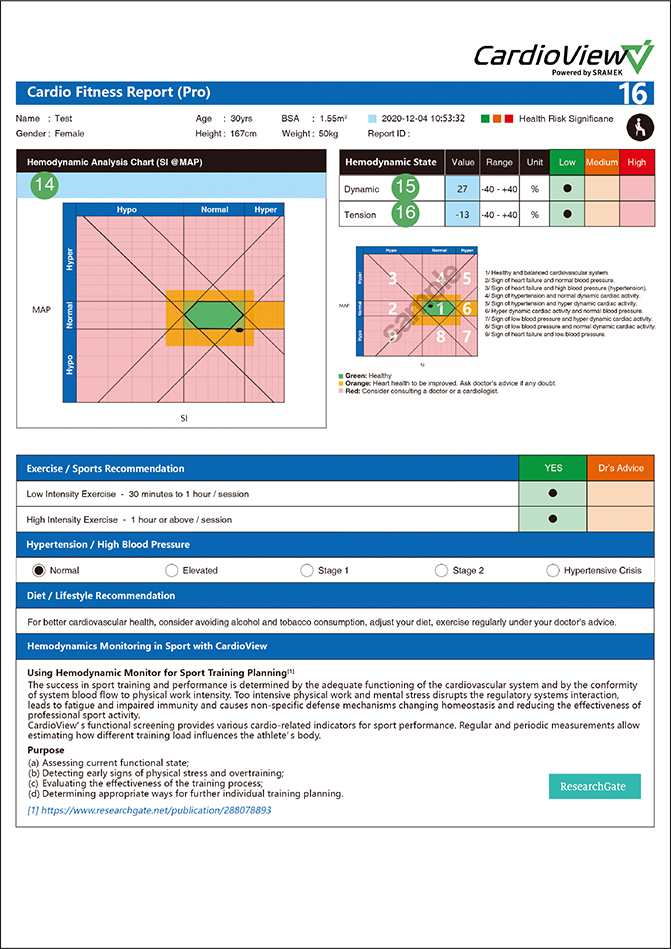
MAP/SI Hexagonal graph
The hexagon indicates the optimal cardiovascular health. The dot represents your hemodynamic balance. When the dot is located inside the hexagon, the high blood pressure risk is minimal.
DYNAMIC
It is the dynamics of blood flow. Hemodynamic response continuously monitors and adjusts to conditions in the body and its environment.
TENSION
It is the pressure of the blood vessels in the circulatory system, often measured for diagnosis since it is closely related to the force and rate of the heartbeat and the diameter and elasticity of the arterial walls.